World Affairs
About 9,000 sailors and Marines head toward Middle East aboard two ship groups
The USS Theodore Roosevelt carrier strike group and Makin Island amphibious group are underway. Navy reporting says Roosevelt is expected to relieve the USS George Washington, making any three-carrier overlap conditional.
Executive summary
- The reported force: The Associated Press reported Thursday that the USS Theodore Roosevelt carrier strike group and the USS Makin Island amphibious ready group together carry more than 7,000 sailors and about 2,000 Marines. AP attributed the figures to an unnamed U.S. official, a separate sourcing basis from USNI News' reporting on the ship departures.[1][2][3]
- Two groups, different roles: Theodore Roosevelt is a carrier strike group. The Makin Island group includes the amphibious ships USS Anchorage and USS John P. Murtha and the 13th Marine Expeditionary Unit. U.S. Naval Institute News reported their departures on Sept. 27 and 28, respectively, citing Navy or defense officials for the ship movements.[2][3][1][4]
- Three carriers are not assured: AP said a third carrier could be in the region if the USS George Washington remains when Theodore Roosevelt arrives. But Navy reporting and The National describe Roosevelt as expected to relieve Washington. The reporting therefore does not establish that three carrier groups will operate there at the same time.[1][2][5]
Two U.S. Navy-led ship groups are heading toward the Middle East with more than 7,000 sailors and roughly 2,000 Marines aboard, the Associated Press reported Thursday, citing an unnamed U.S. official. The combined estimate is about 9,000 people. AP identified the groups as the Theodore Roosevelt carrier strike group and the Makin Island amphibious ready group.[1]
The figure makes clear that the movement involves a large naval and Marine force, but it is an attributed estimate rather than a published Defense Department order. U.S. Naval Institute News separately reported that both groups had departed San Diego, citing Navy or defense officials. The departure reports establish the ships' movements; they do not independently verify AP's personnel total or explain an operational mission.[1][2][3]
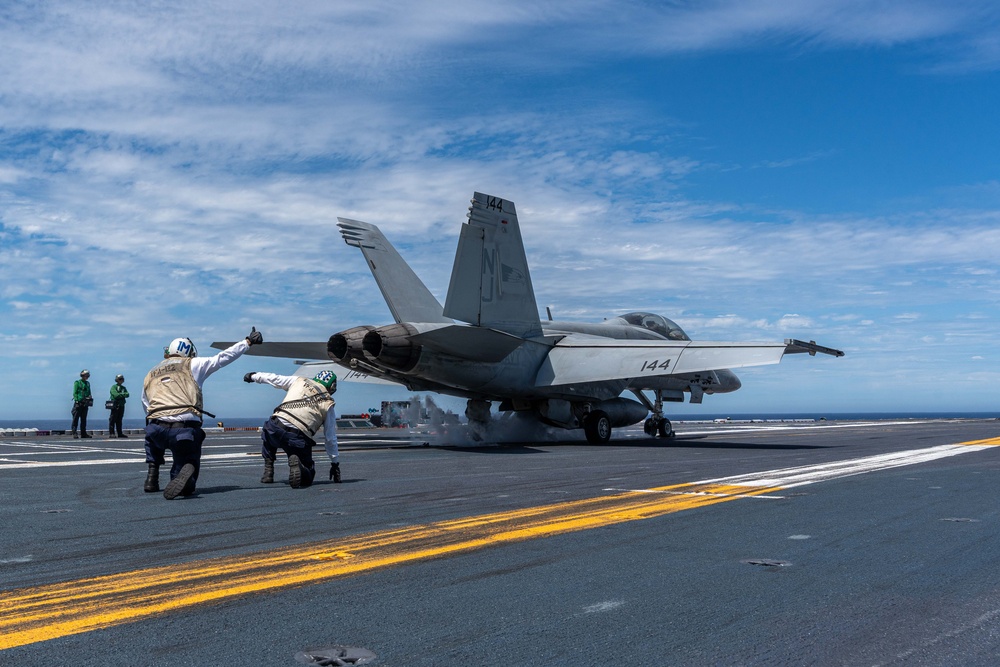
Theodore Roosevelt deployed from San Diego on Sept. 27 for a scheduled deployment, USNI News reported. Its carrier strike group includes the aircraft carrier and escorting warships. The Makin Island group left on Sept. 28 with the amphibious ships Anchorage and John P. Murtha and the 13th Marine Expeditionary Unit, according to USNI News. AP reported that the Makin Island group carries about 2,000 Marines alongside its sailors.[2][3][1]
The groups are not interchangeable: a carrier strike group centers on the carrier and its air wing, while an amphibious ready group deploys landing ships with embarked Marines. The Marine Corps has described the 13th MEU and Makin Island group operating together during routine training off California. The reporting establishes that both groups are moving toward the region, but does not publicly detail where each will operate or what specific tasks it will receive.[2][3][5][4]
AP reported that the arrival could put three U.S. carriers in the region if the George Washington remains there. The Washington is already in the Middle East after moving to relieve the Abraham Lincoln. But USNI News and The National reported that Theodore Roosevelt is expected to relieve the Washington. If that rotation proceeds as expected, the arrival would replace a carrier rather than necessarily add a third one; a temporary overlap is possible, not confirmed.[1][2][5]
The distinction matters because a carrier's presence can change as ships rotate through deployments. The reports do not say that three carrier groups have been ordered to operate together, and the public information reviewed for this article does not resolve how long the Washington and Roosevelt might overlap.[1][2][5]
The deployments come amid the U.S.-Iran conflict. AP reported them as President Donald Trump weighs next steps, including possible renewed strikes. That is the context in the reporting; neither AP nor the ship-movement reports establish that an attack is imminent or disclose a specific mission for either group.[1][5][2][3]
The newly reported total is therefore useful as a measure of the forces now moving, while the details that would explain their operational purpose remain limited in public reporting. The carrier's expected relief of Washington also makes the possible three-carrier count dependent on timing and any change to that rotation.[1][2][5]