Transport & Infrastructure
Spain reports 69 dead in Urda train crash as probe examines dispatch order
Spain’s transport minister said the train was cleared to resume normal travel after a communications failure while a red signal was still active.
Executive summary
- Provisional toll: One more body was recovered overnight, bringing the provisional toll to 69 on Thursday, the regional president told AP. The region's Oct. 28 update had reported 68 deaths — 44 on the Iryo train and 24 on Renfe's AVE — and more than 100 injured; the train-by-train split for the revised toll was not available in the records reviewed.[1][2]
- The collision: Renfe said its Madrid-to-Seville AVE was involved in a collision with an Iryo train near Urda, Toledo, at 8:53 a.m. local time. AP reported the AVE struck the rear of the Iryo train, which had stopped on the tracks.[3][4]
- Cause remains under investigation: Transport Minister Óscar Puente said a preliminary account points to a control-center decision to let the AVE resume normal running after a communications failure, despite an active red signal. That account is not a final investigation finding.[5][6]
One more body was recovered overnight, taking the provisional toll to 69 on Thursday, Castilla-La Mancha president Emiliano García-Page told the Associated Press. The regional government's Oct. 28 update had reported 68 deaths — 44 among passengers on the Iryo train and 24 on Renfe's AVE — and more than 100 injured. Authorities had not published an updated train-by-train split for the 69th death in the records reviewed.[1][2][4]
Renfe said its AVE service from Madrid Puerta de Atocha to Seville Santa Justa was involved in the collision between Los Yébenes and Urda at 8:53 a.m. on Wednesday. AP reported that the Renfe train struck the rear of an Iryo train that had stopped on the track. Renfe said high-speed traffic between Madrid and Andalusia was suspended.[3][4]
Transport Minister Óscar Puente said an automated safety system stopped several trains after a computer communications failure, and that the Renfe train was then authorized to resume normal travel while a red signal remained active. Reuters reported that Puente called the restart decision erroneous. Renfe's statement said the AVE had been authorized to continue before it struck the stationary Iryo train, whose reason for stopping the company said it did not know. These are attributed accounts made while the investigation is under way, not a published final finding about the cause or responsibility.[5][3][4]
Euronews reported the minister's more detailed explanation: a failure in the LZB train-protection system affected a 63-kilometer stretch and automatically stopped around six trains. Puente said the Renfe train was allowed to travel at normal speed even though the red signal remained active; the minister said investigators were examining how the control center made that decision. The exact sequence remains subject to investigation.[6][5]
Renfe said it was preparing alternative travel, including conventional rail services between Madrid, Ciudad Real and Puertollano and a separate plan for passengers traveling between Madrid and Andalusia from Friday, Oct. 30. The company said the conventional routes add about 90 minutes to journey times.[7]
A royal decree published in Spain's official gazette declared three days of official mourning, from midnight Oct. 29 through Oct. 31, with national flags at half-mast on public buildings and Navy ships.[8]
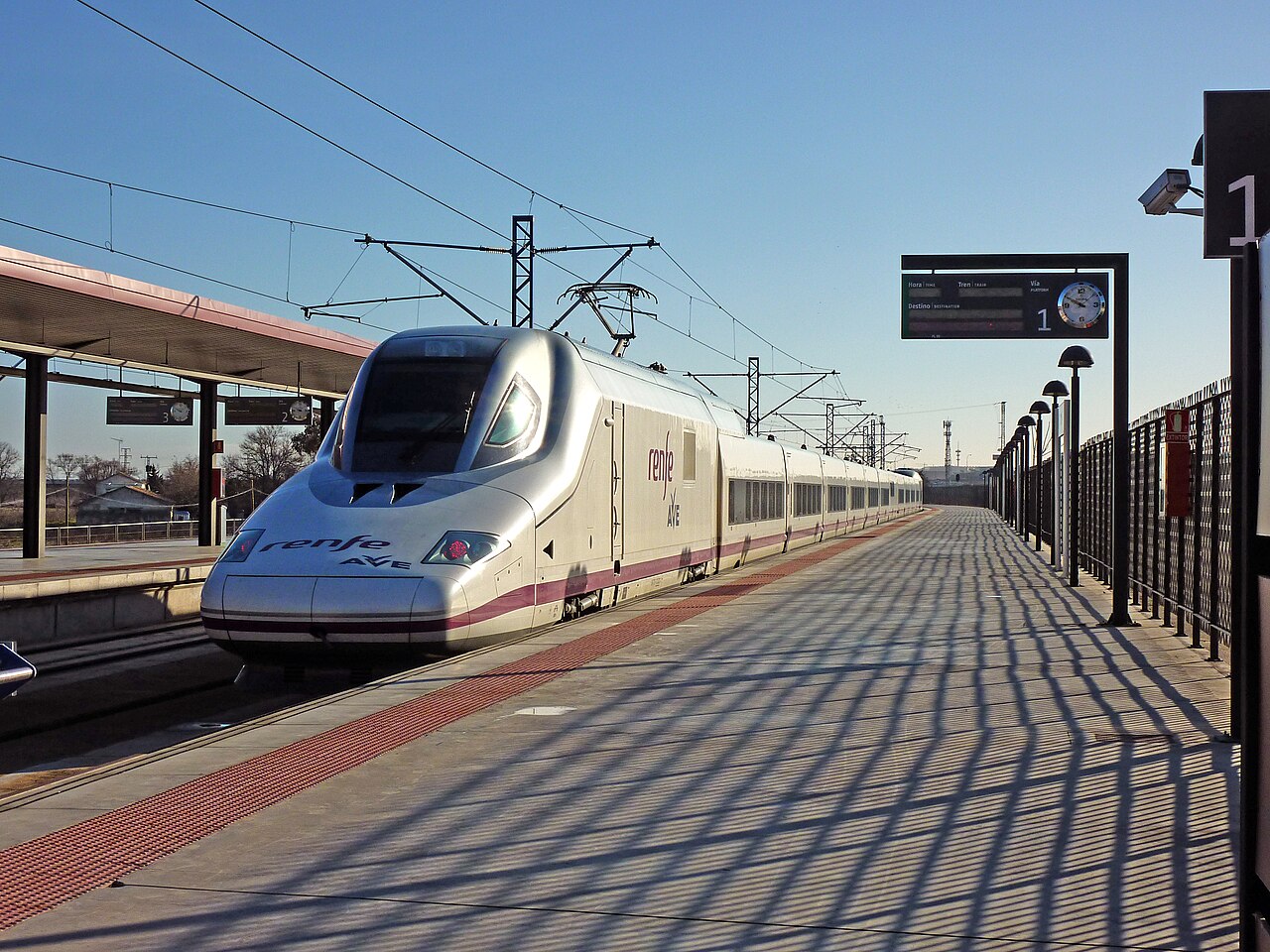
This archival photograph shows a Renfe AVE Class 112 train at Toledo station in 2011. It is a contextual file photograph and does not depict the crash site, the trains involved or the response. Wikimedia Commons identifies the image as the photographer Adbar's work, licensed CC BY-SA 3.0; this copy was resized without other alteration.[9]