World Affairs
Saudi Arabia reports Riyadh missile interception as airport reopens
The coalition announcement followed a late-Saturday drone interception and came as airport terminals resumed limited service. An AFP journalist heard three explosions in Riyadh, but the accounts reviewed did not establish that a projectile struck the airport.
Executive summary
- A new interception was reported Sunday: The Saudi-led coalition said air defenses intercepted and destroyed a ballistic missile launched toward Riyadh. Qatar News Agency reported a drone interception late Saturday, while AFP reported two drones intercepted in the capital area; the accounts do not make clear whether those were the same or separate events. Saudi Civil Defense said an aerial-threat alert was issued Sunday.[1][2][3]
- Explosions were heard, but an airport strike was not confirmed: An AFP journalist heard three explosions in Riyadh and reported that residents received alerts urging them to seek safety. The coalition described an interception, and the accounts reviewed did not confirm that a projectile hit the airport or caused damage.[3][1]
- The airport began a limited reopening: King Khalid International Airport said Terminal 1 would serve domestic flights and Terminal 2 international flights operated by national carriers, and asked passengers to confirm their bookings. AFP reported a plane taking off early Sunday.[4][3]
- Saturday’s western debris report remains disputed: Saudi Civil Defense said debris from two intercepted ballistic missiles fell in four western locations and described the missiles as directed toward Makkah and Madinah. Houthi spokesman Yahya Saree denied that targeting account; the statements did not independently establish the missiles’ origin or intended targets.[5][6][7]
The Saudi-led coalition said Sunday that air defenses intercepted and destroyed a ballistic missile launched toward Riyadh. The Saudi Press Agency carried the statement from coalition spokesman Maj. Gen. Turki Al-Maliki. The brief release did not identify where the interception occurred or report casualties or damage.[1]
Qatar News Agency, citing coalition announcements, reported one drone interception over the Riyadh region late Saturday. AFP reported that the coalition had downed two drones in the capital area, as well as the Sunday missile. The reports do not clarify whether they describe the same drone incident or additional interceptions. Saudi Civil Defense separately said an alert about a potential threat had gone out through the National Early Warning Platform. These accounts do not establish that the missile reached or struck the airport.[2][3]
An AFP journalist reported hearing three explosions in the capital in the early hours of Sunday; residents received messages warning of a hostile aerial threat and urging them to take shelter. The witness account documents what was heard, while the coalition described an interception. The reporting reviewed here did not confirm an impact site or resulting damage.[3][1]
The airport said Terminal 1 would handle domestic flights and Terminal 2 international flights operated by Saudi national carriers, effective Sunday. It advised passengers with confirmed bookings to check with their airlines before traveling. AFP reported that a plane took off early Sunday as service resumed after a two-week closure.[4][3]
The reopening announcement came alongside renewed security warnings. AFP reported that Houthi military spokesman Yahya Saree described the airport as unsafe and a military target. That is a statement by a party to the conflict, not independent evidence of an attack on the airport on Sunday.[3]
Saudi Arabia’s Civil Defense said on Saturday that debris from two intercepted ballistic missiles fell in four western locations. In a statement carried by the Saudi Press Agency, the agency said the missiles had been launched toward the Makkah and Madinah regions.[5]
The statement listed Wadi Al-Mughammas in Makkah, the Al-Nuzha neighborhood of Jeddah, Wadi Jalil in Taif and the Masturah area of Rabigh. It said emergency teams responded and followed established procedures. The public statement did not give a casualty count or describe damage.[5][8]
Yahya Saree, the Houthis’ military spokesman, denied that the group targeted the direction of Makkah or Madinah. The Houthi-run SABA news agency published his statement, which called the Saudi account a fabrication and said the group’s operations target oil facilities and military bases.[6][7]
Saree’s statement did not identify the two intercepted missiles or say whether they were part of the operations he described. His denial is the account of a party to the conflict; it does not establish the missiles’ origin or intended targets.[6][5]
Reuters reported earlier Saturday that the Saudi-led coalition said it destroyed two ballistic missiles launched toward Yanbu and Taif. Saudi Civil Defense later described debris in the Makkah and Madinah regions. The statements reviewed here do not explain whether those accounts refer to the same two missiles or separate interceptions.[8][5]
Reuters also reported that the Houthis claimed attacks on Saudi airports and oil facilities, while Yemen’s internationally recognized government said Houthi missiles struck coast guard sites in Aden. The news agency said it was not immediately clear whether any of the reported attacks hit their claimed targets. Those claims do not independently verify the Saudi or Houthi account of where the intercepted missiles were aimed.[8]
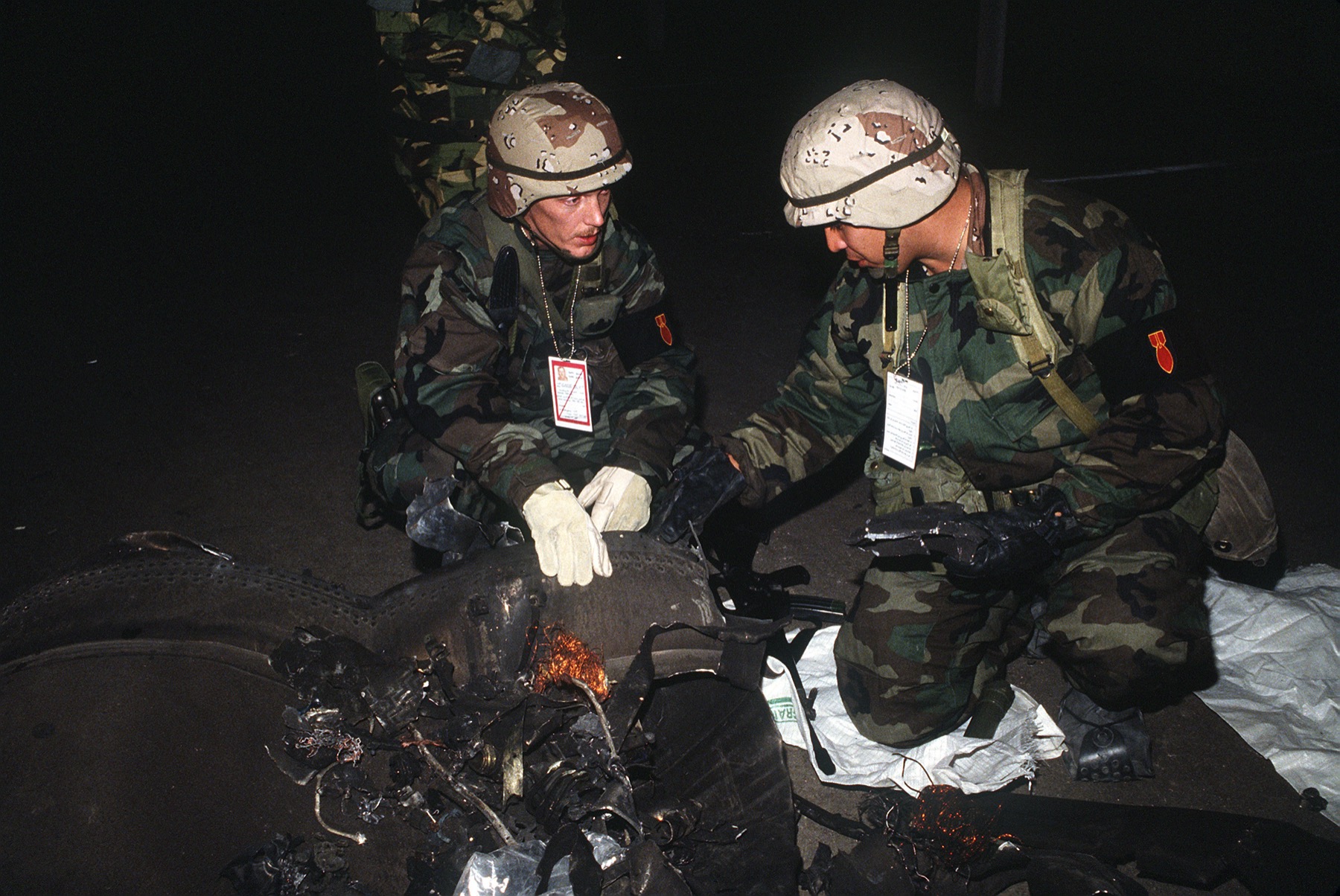
This file photograph shows explosive-ordnance technicians examining remains of an Iraqi Scud missile intercepted in Saudi Arabia during Operation Desert Storm in February 1991. It is archival context and does not depict the October 2026 missile reports or debris.[9]